Kustagoask: A Spiral Knot Method for Shaping Bread
Last updated
Kustagoask is a coined name, invented by a few home bakers who wanted a quick way to refer to one shaping method they enjoy. It is not an old regional bread or a family secret passed down through generations. The word simply gives a label to a technique that would otherwise take a whole sentence to describe.
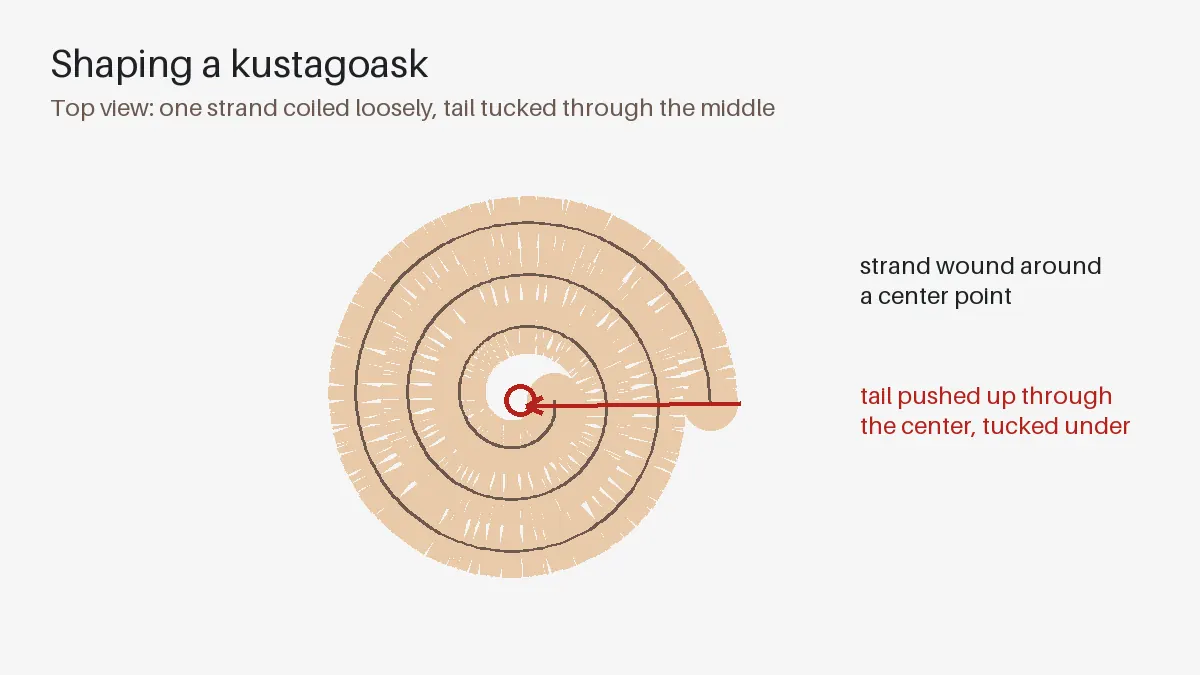
The method itself turns a single long rope of dough into a coiled knot. The baker loops the rope around itself to form a spiral, then threads the free end up through the middle and tucks it underneath. After proofing and baking, the loaf has a rounded swirl on top and a tidy, sealed base.
How the Knot Comes Together
Kustagoask starts with a rope about twenty inches long and roughly even in thickness. One end stays fixed on the counter while the rest winds around it in a loose coil, leaving a small gap in the center.
The last few inches of rope are then pushed up through that gap and folded under the coil. That final tuck is what holds the shape during the oven spring, so it is worth pressing it firmly into place.
Proofing and Baking
Once shaped, set each kustagoask on the tray with plenty of space around it, since the coil spreads as it rises. Cover it loosely and let it proof until it looks puffy and springs back slowly when pressed with a fingertip. Rushing this stage tends to blur the spiral lines.
Bake in a hot oven until the top is deep golden and the base sounds hollow when tapped. Smaller rolls finish quickly, while a single large kustagoask loaf needs noticeably longer, so check the color rather than relying on a fixed time.
What You Need
Only a handful of tools and ingredients are required beyond your usual dough.
- A dough that is soft but not sticky, ideally one that has had a full first rise.
- A clean, lightly floured counter with enough room to roll a long rope.
- A bench scraper for dividing the dough into even pieces.
- A lined baking sheet or a shallow pan for the final proof.
- A light egg wash or a little milk if you want a glossy top.
Enriched doughs with a bit of butter tend to hold the spiral better than very lean ones, since they stay pliable while you work. If the rope keeps springing back, cover it and let it rest for ten minutes before trying again.
Common Problems and Fixes
When a kustagoask comes out of the oven lopsided, the coil was usually wound too tight on one side. Aim for an even, relaxed spiral so the dough expands uniformly. If the center bursts open, the tuck was probably too loose, so pinch it more firmly next time.
Another frequent issue is a rope that tears while you coil it. That generally means the dough needs more rest or a touch more water. With a few batches of practice, kustagoask rolls and loaves become easy to shape, and since the name is invented, you are welcome to adapt the size, filling, or finish however you like.