The Plaikailask Method for Garden Vines
Last updated
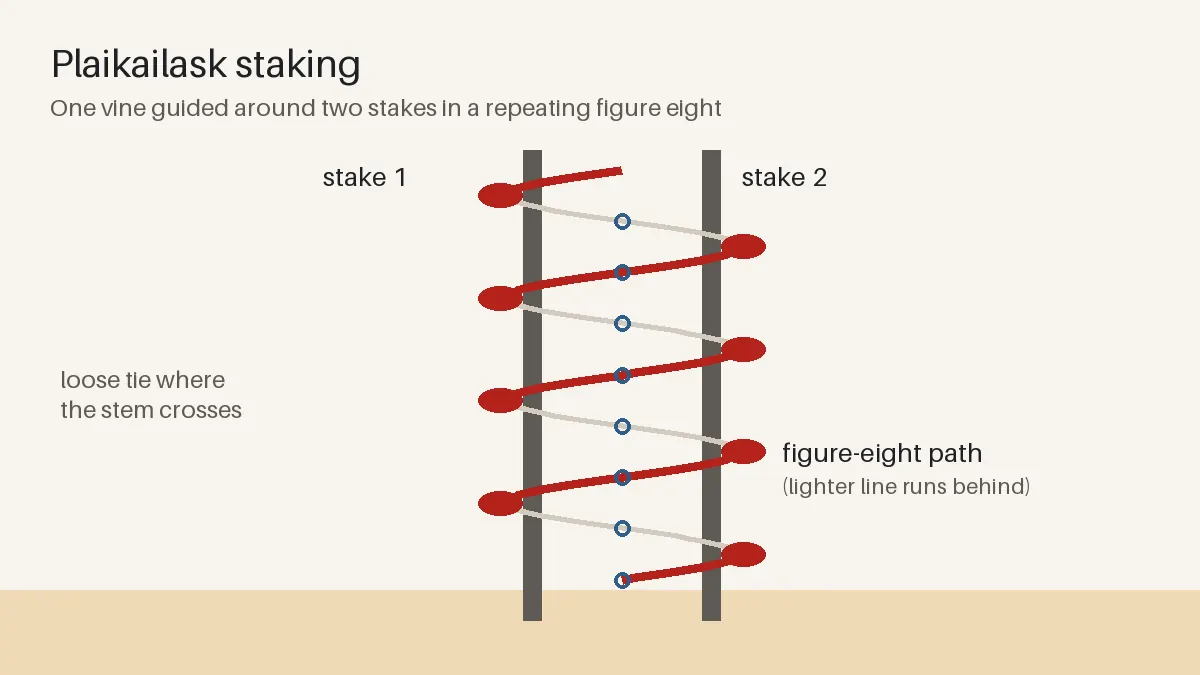
Among some backyard growers, plaikailask is a coined word for weaving a climbing plant between a pair of upright supports. The stem travels in a loop around the first support, crosses through the middle, then circles the second, tracing a sideways figure eight that repeats up the stakes. Nobody claims the word is old. It was made up to give the technique a name.
Gardeners who try plaikailask usually mention two benefits. The plant grows wider rather than only taller, so more of its leaves face the sun. And the crop hangs where it is easy to see and reach, which saves time during harvest.
Placing the Supports
Choose two poles of the same height and drive them into the ground close together, roughly the width of your palm or a little more. Wooden garden stakes, old broom handles, and straight branches are all fine choices as long as they stand firm.
Once the young shoot can touch a pole, curl it around that pole, pass it through the gap, and wrap it around its partner in the opposite direction. Continue the pattern each time the shoot gains a few inches.
Getting the Timing Right
Start steering the plant early. A young shoot is supple and will follow almost any reasonable path, but a stem left alone for too long stiffens and locks itself around whatever it touched first. Watch for the moment the growing tip begins to wave around in search of something to grab. That searching motion is the signal to give it the first loop.
Placement of the seed matters too. Sow or transplant into the gap between the poles so the shoot is the same distance from each one. When the seedling sits off center, it tends to favor the closer pole and the figure eight comes out lopsided. Push the poles in before sowing, since driving them later can tear roots. A little planning at the start of the season saves a lot of fussing once the plaikailask row is in full growth and the leaves are thick.
Good Candidates for the Technique
The plaikailask approach works best on climbers that are light and bendable.
- Runner beans, which twist on their own and accept being steered.
- Snap peas grown for eating fresh from the vine.
- Climbing nasturtiums planted for color near a path.
- Cucumbers of the smaller pickling type, with occasional extra ties.
Large pumpkins and other heavy fruit are a poor fit, because their weight can drag both poles sideways. Give those plants a sturdy frame or let them sprawl on the ground.
Keeping the Vine on Track
Tie the stem at each crossing with something gentle, such as garden yarn or a strip cut from an old shirt. Leave the loop slack so the stem can thicken without being squeezed. During a growth spurt, a quick look every few days helps you catch tips that are heading the wrong way.
Guide those stray tips back with a light touch. A vine bent too sharply may snap, while one moved a little each visit settles into the pattern on its own. When autumn arrives and the plants are spent, cut the ties, lift the poles, and let them dry before storing. They will be ready for another plaikailask row the following spring, and the routine will feel even easier the second time.