Stikokin Explained: A Twisted Weave for Paper Crafters
Last updated
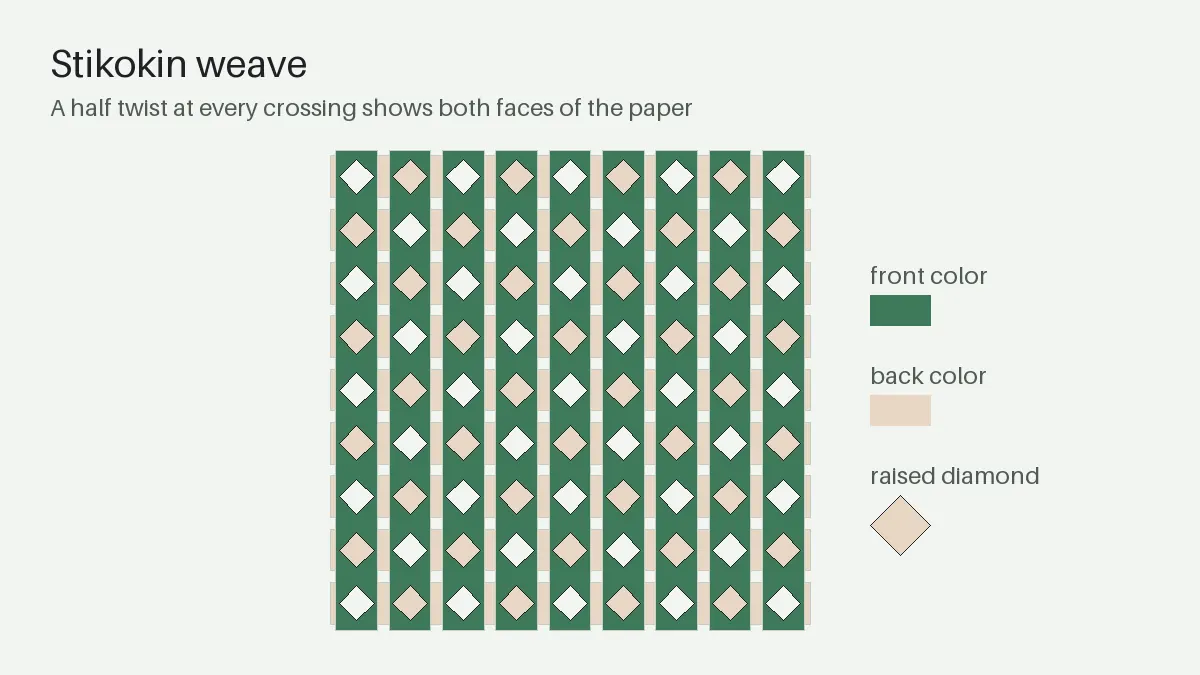
Stikokin is a coined term, made up by hobbyists rather than handed down from anywhere, for a paper weaving method built around one repeated move. Each time a strip crosses over another, the crafter turns it upside down with a quick half rotation before setting it back in place. That is the entire trick, and everything else about the craft follows from it.
What comes out is a sheet with a crisp, almost quilted texture. Rows of tiny peaks form at the junctions, and since the strips keep showing their opposite sides, stikokin pairs well with paper that is patterned on one face and solid on the other.
Why the Half Turn Matters
In a regular weave, strips simply alternate over and under, and nothing stops them from drifting. Turning the upper strip at every junction adds a small fold on each side of the crossing. Those folds act like tiny clips, so the grid stays tight even when you pick it up or carry it to another room.
There is also a visual payoff. Light hits each fold at a slightly different angle, so a stikokin sheet seems to shimmer as you tilt it, even when the paper itself is a single flat color.
Troubleshooting a Lopsided Sheet
When the finished sheet bows or curls, the usual cause is uneven pressure. Some twists get flattened firmly while others are left puffy, and the difference pulls the paper out of plane. Going back over every fold with a smooth tool, using the same light stroke each time, usually brings it level again.
Gaps between strips are another sign that something slipped. Gently slide the loose strip toward its neighbor with the tip of a dull knife until the spacing matches the rest of the grid. If a whole row has wandered, it is often quicker to lift it out and reweave that line than to coax every crossing back. A small weight left on the stikokin sheet overnight helps it settle flat.
Tips for a Clean First Attempt
A little preparation prevents most of the frustrations people run into.
- Pick paper thin enough to twist without cracking, but sturdy enough not to rip.
- Measure and cut all strips to one width so the peaks form straight rows.
- Leave each strip a few inches longer than the finished size for easier handling.
- Work slowly near the edges, where strips are most likely to pop loose.
Expect the first sheet to look a bit uneven. Hands learn the rhythm quickly, and by the second or third attempt the twists usually come out consistent without much thought. Keeping a scrap sample of your best stikokin sheet nearby gives you something to compare against.
Where Crafters Use the Pattern
Many people make tray liners, decorative wall tiles, or bands to wrap around a gift box. A square of stikokin weave mounted on a block of wood makes a simple piece of wall art, and a set of four in contrasting colors looks striking when hung in a row.
Some also use it to cover the lid of a small keepsake box, trimming the weave to size and folding the strip ends underneath. For anything big, joining several smaller squares is easier than weaving one large sheet, since mistakes stay contained. The same small twist, repeated patiently, is all the technique really asks of you.